
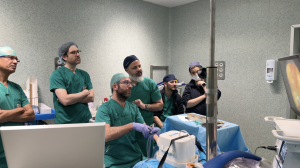
On January 16, 2026, ROC Clinic began its annual training program in Benign Prostatic Hyperplasia (BPH) in collaboration with Urology 3D through an advanced course in prostate laser enucleation, designed to offer urologists an intensive learning experience based on high-fidelity surgical simulation. The activity was held at the Hospital Universitario HM Sanchinarro, reaffirming its role as a reference environment for state-of-the-art urological training.
This course marked the beginning of a year aimed at strengthening the technical training of specialists in minimally invasive procedures, with a focus on patient safety, surgical precision and teaching excellence.
Surgical simulation as a learning axis
The central element of the day was the use of the ProstaSIM simulator, a 3D simulation platform developed by Urology 3D that allows the prostate anatomy and the different steps of prostate laser enucleation to be reproduced with great realism. Thanks to this technology, participants were able to train the technique in a controlled, repeatable and risk-free environment, favoring a progressive and structured learning curve.
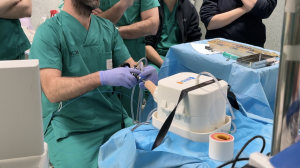
The program combined theoretical sessions aimed at consolidating the anatomical and technical fundamentals of enucleation with practical blocks in which attendees worked directly on the simulator. During these practices, key aspects were addressed such as:
- Identification of anatomical planes during enucleation.
- Laser management and optimization of the applied energy.
- Prevention of intraoperative complications.
- Decision-making in different simulated clinical scenarios.
This approach allowed the urologists to improve their technical skills and gain confidence before transferring what they learned to actual clinical practice.
Personalized teaching and realistic clinical approach
The course counted with the participation of a teaching team with extensive experience in prostate surgery and laser techniques, led by Dr. Javier Romero-Otero and Dr. Fernando Lista Mateos, who accompanied the attendees throughout the training process. The direct interaction between teachers and students facilitated dynamic learning, with individualized feedback and resolution of doubts in real time, adapting to the level and experience of each participant.
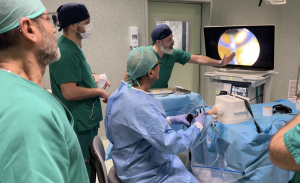
The diversity of professional profiles -from urologists in the initial stages of their specialization to specialists with consolidated careers- enriched the exchange of knowledge and favored a multidisciplinary approach, aligned with the real needs of current urological practice.
Commitment to innovation and ethical training
With this course, Urology 3D reinforces its commitment to simulation as a key tool in modern medical training, promoting an educational model that reduces dependence on direct patient training and prioritizes safety, ethics and quality of care.
The use of technologies such as ProstaSIM makes it possible to standardize the teaching of complex techniques, improve the reproducibility of training results and contribute to a better preparation of the professionals involved in the surgical treatment of BPH.
Are you a urology specialist looking to improve your surgical technique in laser prostate enucleation? Come in and find out how our prostate models can help you: ProstaSIM Simulator